
More customers, more emails, more Excel. And everything depends on one person.
Standard orders eat up half a morning, and special cases go through two people, three emails, and a spreadsheet. When the key person is on vacation, order intake grinds to a halt. In your own portal, your customers place orders themselves: with your prices, your configuration, and your rules, in minutes and around the clock. A PIM and custom integrations connect product data, shop, ERP, and warehouse.
You wanted to grow. Without being stuck in every single order.
Orders come in, and business is running. Still, order intake gets tighter the more customers you have. Three layers, the same root.
Your order intake keeps office hours.
Orders by email, phone, and PDF sit there until someone has time. On top of that, customers ask about status, delivery notes, and invoices, and every follow-up question is another phone call.
You’re the door everything has to go through.
Growth doesn’t feel like success; it feels like more weight on the same shoulders. Today, more customers means more manual work, not more time for the business.
Standard shops have no vocabulary for your specialty.
As soon as your prices, configurations, or workflows are special, an off-the-shelf shop squeezes you into someone else’s structure. That’s the wrong direction.
“Too specialized for standard software? Good. That’s not an obstacle, that’s the reason.”
The B2B ordering portal as the digital front door to your business.
At Unique-P, your business gets a custom-built B2B portal that maps your special logic, central product information in the PIM, and integrations that connect your systems. You can also start with the PIM integration or a single interface for your existing shop.
Ordering and reordering
In the B2B portal, your customers order in self-service with your prices, your quantities, your terms. Repeat orders take two clicks.
Configurators & special logic
The special logic that lives in people’s heads and emails gets coded into the B2B portal: configurators, approvals, tiered pricing, customer-specific terms.
Quotes, documents, status
In the B2B portal, customers request quotes, see the order status, and download delivery notes and invoices. Instead of callbacks and email ping-pong.
Integration development
Custom integrations from Unique-P connect shop, ERP, PIM, and warehouse: products, prices, and stock levels get synced, and orders get sent back, with data preparation and error logging.
PIM & product data
With a PIM, you maintain product information centrally and use it in shops and portals: descriptions, images, variants, and translations. Unique-P connects and extends your PIM, such as Akeneo, including imports from existing data sources.
Admin back end for your team
In the portal’s admin back end, your team runs operations from one place: review orders, approve special cases, maintain content, manage customers.
Your code, no license rent
The code of a B2B portal built by Unique-P belongs to you and lives in your company’s repository, cleanly documented and built for handover. No monthly platform fee, no vendor lock-in.
This is what a custom-built B2B portal looks like.
Two examples from demo portals show what custom-built B2B portals look like: a 2D deck planner with a rules engine and bill of materials for the timber trade, and an IT procurement portal with a web shop, approvals, and repair handling.
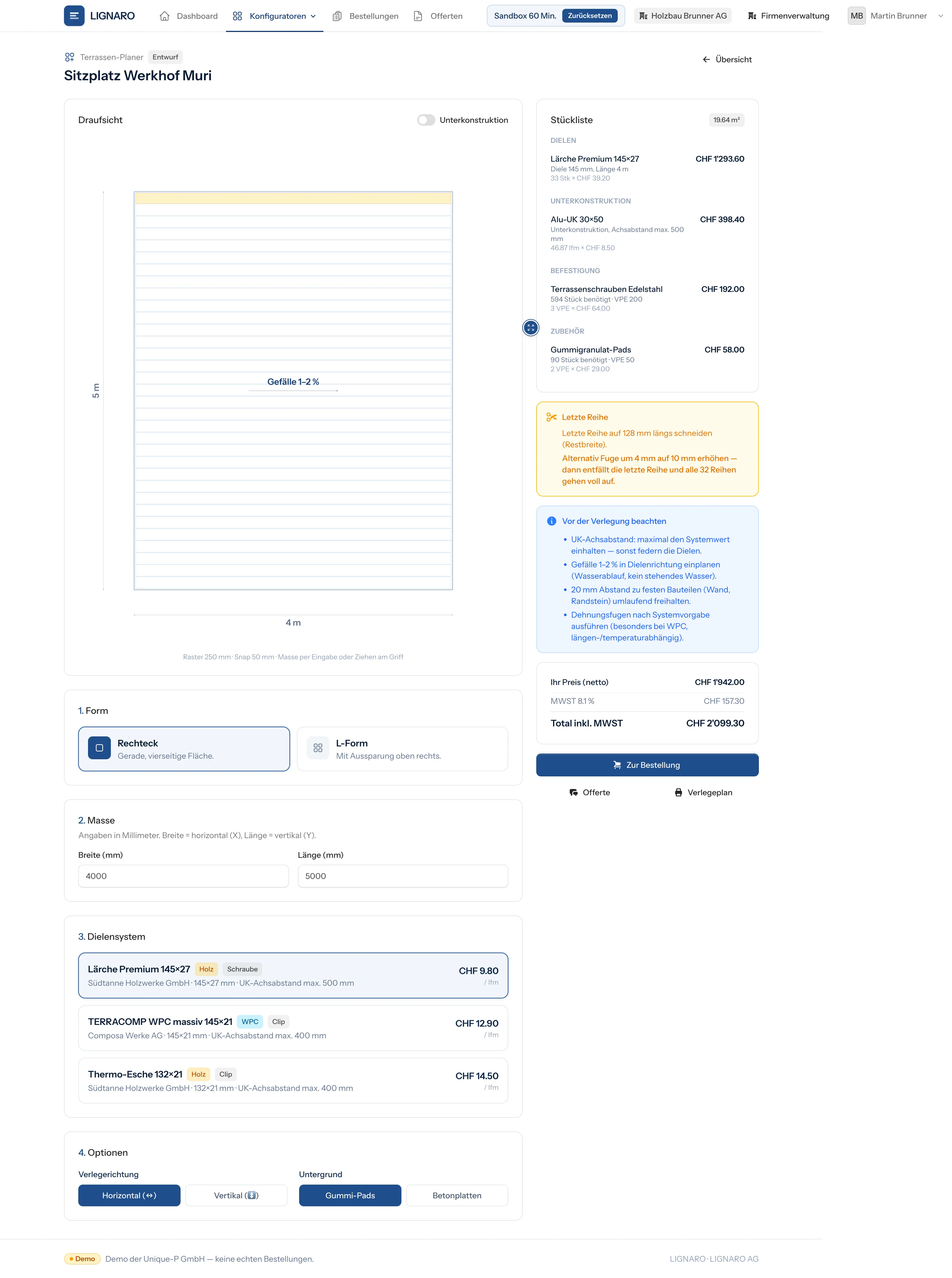
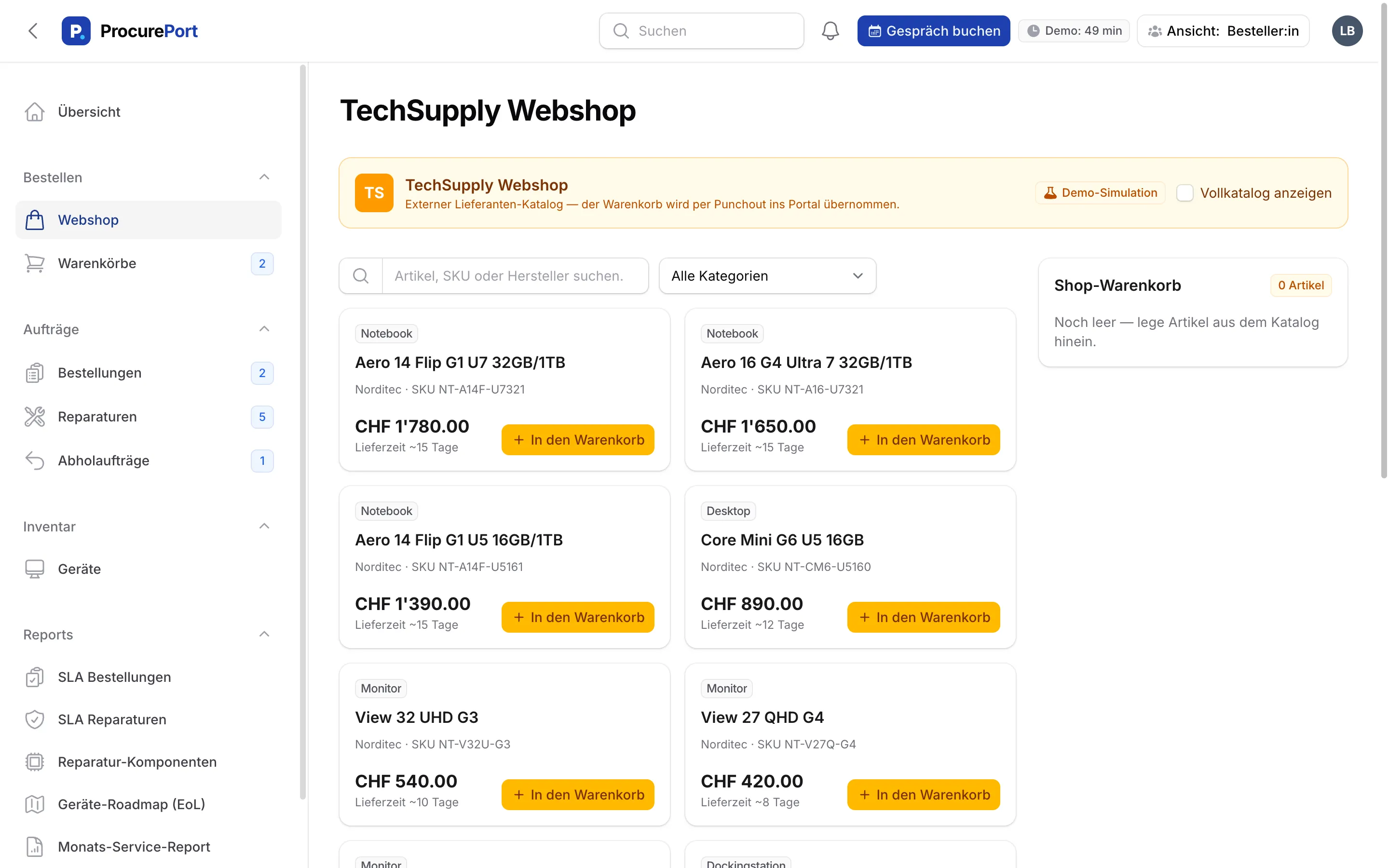
Wood cutting with a configurator: orders in minutes instead of hours or days.
In the Unique-P wood-cutting project, standard cuts used to go through sales, production, manual calculation, and ERP quotes. After: a self-service portal with a configurator, automatic calculation, and SAP integration, including machine data for production.
~95%
of orders go through the wood-cutting portal without a manual quote
Minutes
instead of hours or days until a cutting order is complete
SAP
cleanly connected to the portal, not replaced: prices and stock levels in real time
Source: project Wood-cutting configurator with SAP integration, figures from project completion.
Three steps to workflows that work.
Book a call
The call with Unique-P takes 30 minutes and is free. You describe your ordering workflows, product data, and systems and get an honest answer on whether a portal, a PIM integration, or a single interface makes sense.
Get a blueprint
The blueprint from Unique-P is a solid diagnosis: what’s really special, where product data is maintained, and which systems need to exchange data. With phases and fixed prices, no obligation to build.
Use the solution
At Unique-P, the portal, PIM integration, or system integration takes shape in fixed-scope phases. You check early, with real products and orders, whether the workflows work.
24/7
Orders keep coming in through the portal, even at night and on weekends
Zero
key-person risk: the portal knows your rules
+
Growth without new hires in order intake
If you wait on the ordering portal, every order stays manual work, every vacation a risk, and every growth opportunity a staffing problem. The call with Unique-P takes 30 minutes.
Frequently asked questions about B2B e-commerce, PIM & integrations.
How much does a B2B ordering portal cost?
What a B2B ordering portal costs depends on special logic, integrations, and the roles and permissions model. After the free initial call, you get a blueprint from Unique-P with phases and a fixed price per phase; the first usable version goes live after a few weeks. There’s no credible flat price, but after the diagnosis there’s a binding fixed price per phase.
When is Shopify or Shopware enough, and when do you need a custom build?
A standard shop like Shopify or Shopware is enough if prices, products, and workflows are largely standard, and that’s exactly what you’ll hear from Unique-P. As soon as customer-specific prices, configuration, approvals, or tight ERP integration are at the core, the standard squeezes you into someone else’s structure: that’s when a custom-built portal is the better fit.
How does the portal connect to our ERP?
A B2B portal from Unique-P connects to your existing ERP through integrations: SAP, Akeneo PIM, FileMaker, and others are proven in the portfolio. Prices and stock levels come from the ERP in real time where needed, and orders flow back. Your back end stays untouched.
What does a PIM do for us?
A product information management system (PIM) brings descriptions, images, technical attributes, variants, and translations together in one place. Your team maintains product information centrally and passes it on to shops and portals. Unique-P connects and extends your PIM, such as Akeneo, with the imports and integrations it needs.
Do you also build integrations for an existing shop?
Yes, Unique-P also builds integrations for an existing shop: PIM integration and integration development are also standalone projects. Your existing shop, whether Shopware, Magento, or Shopify, gets connected to ERP, PIM, or warehouse: data arrives in the target system ready to use, and errors stay traceable. You don’t need a new ordering portal for that.
Taking over and supporting a Shopware shopOur shop runs on Magento. Connect it or replace it?
A Magento shop can be connected or replaced; both are possible. A running shop can be connected to ERP, PIM, and warehouse. If it has drifted far from the standard, replacing it can make more sense than any further customization: in one Unique-P portfolio project, only around 20 percent of Magento’s standard features were still in use, and the platform was redeveloped on Laravel, with SAP and Akeneo integration.
Taking over and supporting a Magento shopHow long does it take to build an ordering portal?
At Unique-P, building an ordering portal runs in fixed-scope phases: a first version is usable after a few weeks, then the portal grows phase by phase. You see early on whether it holds up, instead of at the end of a long project.
Can customers order special cases and configurable products themselves?
Yes, customers can order special cases and configurable products themselves; that’s exactly what a custom-built B2B portal is for: configurators, approval workflows, tiered pricing, and customer-specific terms get coded into the portal. In the Unique-P timber trade case, around 95 percent of orders go through this way without a manual quote, including machine data for production.
Who owns the portal’s code?
The code of a B2B portal built by Unique-P belongs to you. Code and documentation live in a repository in your company’s GitHub organization from day one, built for handover, with no monthly platform fee and no vendor lock-in. You can take it in-house or switch at any time.
B2B e-commerce from the portfolio.
Wood cutting configurator with SAP integration and machine data generation
Ordering custom-cut wood took several days. Now it takes a few minutes, and the SAP-connected configurator covers over 95% of order requirements.
Magento 2 migration to a custom Laravel e-commerce application with SAP, Akeneo and Algolia integration
The B2B shop used only about 20 percent of Magento 2’s standard features. The new Laravel platform pulls prices and availability from SAP in real time.
Data integration from ERP to Shopify with data conversion, cleanup and fallbacks
The ERP knows neither the variant structure nor the fields Shopify requires. A Laravel middleware prepares the product data and syncs it.